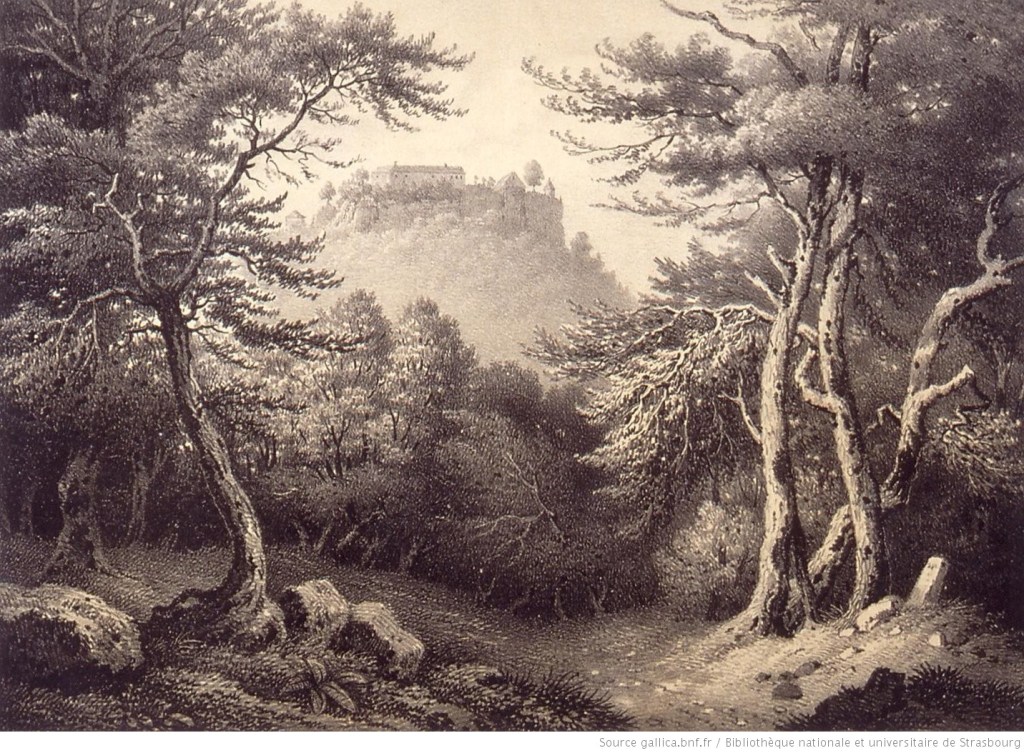
(Illustration “Sainte-Odile” by François Baumann, 1857)
(Originally posted on Patreon, February 2023).
In complete contrast with the last post, this “redemption” story leaves a bad taste in my mouth. I’ve put off translating this folktale for years for various reasons, but the emphasis on the father’s part of Odile’s story is one of them. Yet I can’t really escape that the Alsatian region has a particular set of folktales that should at least get mentioned in passing since they’re so, well, famous. (Like the giant toddler who escapes its giant parents, or Hans Trapp who in the legends I’ve read does rather horrific things to children but seems to be an actual historical figure who…isn’t quite a cannibal? Should I translate these tales to be completionist? Erghh?) I’ve waffled so long on Saint Odile that I told myself it’s time to make a decision. …But I waffled still more in searching for other versions in the public domain after the first version I translated made me twitch particularly.
Yet Mount Saint Odile is gloriously gorgeous. And her being radiates from her tale.
Someone please tell the full tale from her perspective. I beg you, folklorists of the past.
But maybe a saint’s story from a saint’s perspective is too intimidating.
(Meanwhile, yes, the father’s name does change depending on who is telling the story. Folklorists are aware of this issue. *hangs a lantern on it*)
Around the year 660, the duke Adalric governed the land of Alsace. His wife was the pious Béreswinde. Together, they resided either in their château at Obernai or in the one at Hohenbourg. The first child to be born to their marriage was a blind girl; Adalric would have preferred a son. Moreover, as the child was weak and infirm, he attempted to have her killed.
But the mother confided her in secret to a nurse from Scherwiller who took care of the child, and, several days later, brought her to a convent far from Alsace. There, the little girl was baptized and received the name Odile. During the baptism, she completely recovered her sight. Odile remained at the monastery, and there she grew up.
When she was older, the desire took her to return to her parents, and one of her brothers came to convey her.
When Adalric saw the vehicle bringing Odile arrive, he demanded of his son: “Who is it that is arriving?”
The son responded: “That is my sister Odile. I had her brought here.”
The father, in an excess of rage, killed his son whom he had liked rather well. But, taken with remorse, he welcomed his daughter anyway.
Not long after, Adalric attempted to marry off his daughter, although she had witnessed to him the desire to enter a convent.
In grief to see herself thus treated, the young maiden fled, passed over the Rhine, and, pursued by her father, sought shelter beneath the overhang of a rock. She supplicated God to protect her; the rock opened and hid Odile until the danger had passed.
At last, Adalric called back his daughter, forgave her, and declared he would not go against her wishes. He gave her the château of Hohenbourg where she built a monastery: this is the convent that bears the name of its founder, the convent of Saint Odile.
Laurent Delcasso’s version, 1845:
Odile was born blind in 657, of Éthicon, duke of Alsace, and of Béreswinde, niece of the famous bishop of Autun, Leodegaire or Ledger. The three sons of Clovis II then occupied the throne under the tutelage of their mother, Saint Bathilde, who was removed a little later from these affairs by Ebroïn. Raised at the monastery of Baume-les-Nonains, Odile miraculously recovered her sight at the moment of her baptism. Having returned to the castle of her father, she took flight in order to escape a marriage to be held against her wishes. God did not return her to her family until the duke decided to let her follow a pious vocation. This holy daughter died in 760 in the convent that she founded on the mountain that bears her name. See “The Life of Saint Odile” written by Father Hugues Peltre.
If you’ve enjoyed this series of folklore translations and would like to support my further translation endeavors, please feel free to support my work on Patreon.
 little translator